How Many Porta Potties Do You Need for an Outdoor Event in Nashville?
Planning an outdoor event in Nashville comes with a long checklist, permits, vendors, staging, security, parking. One of the most important logistical decisions is restroom planning. Too few units leads to long lines and unhappy guests. Too many means unnecessary cost. So how many porta potties do you actually need?
Here’s a structured, calculation-based guide to help you plan correctly for events in Middle Tennessee.
Step 1: Start with the Base Event Formula
For most outdoor events, the standard starting point is:
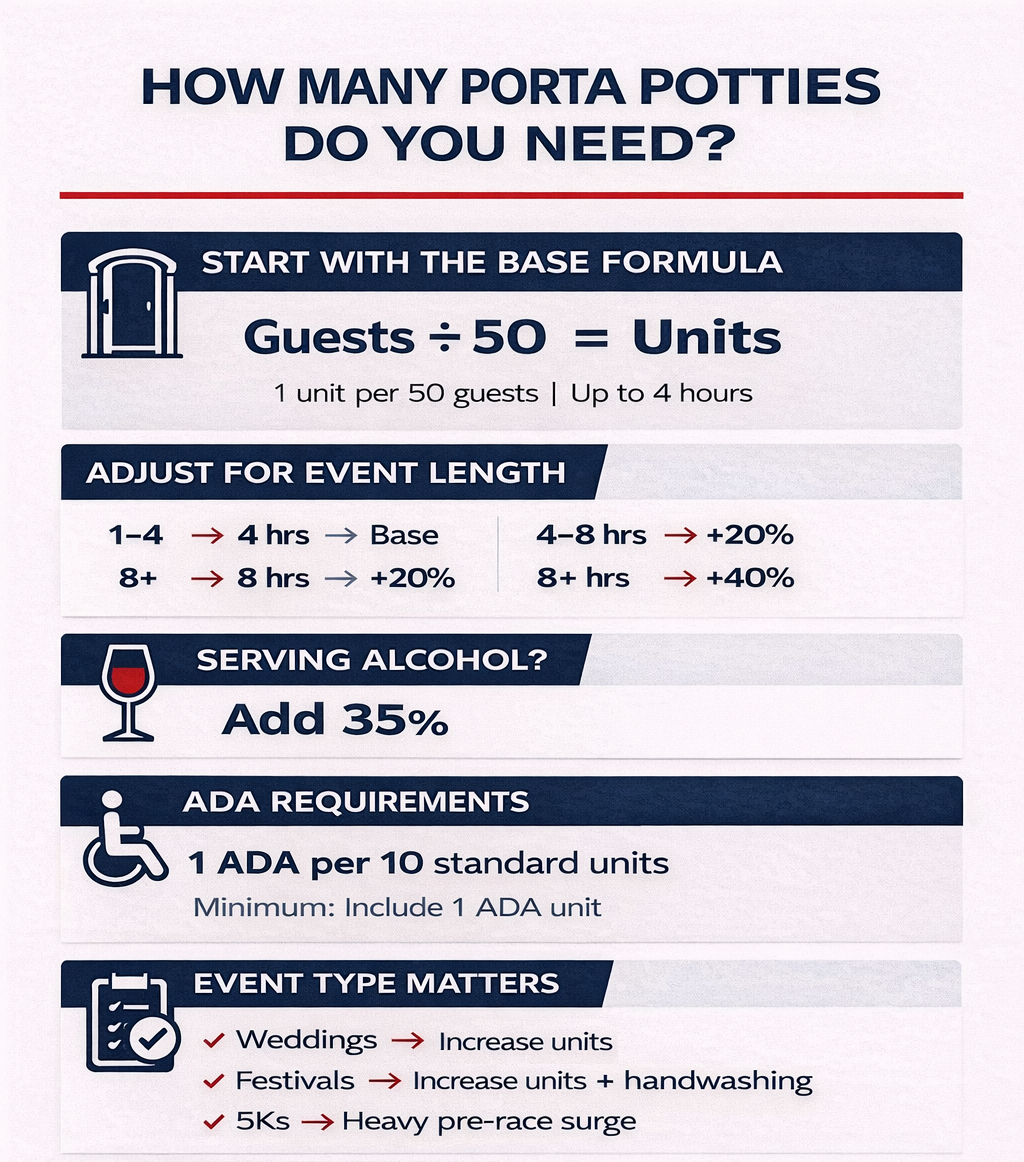
1 portable toilet per 50 guests for up to 4 hours
This assumes:
Moderate attendance flow
No heavy alcohol consumption
Standard guest demographics
Single-day event
Quick Calculation Table (4-Hour Event)
Number of Guests Minimum Toilets
50 1
100 2
200 4
300 6
500 10
1,000 20
Formula:
Total Guests ÷ 50 = Number of Units
Always round up to the nearest whole number.
Step 2: Adjust for Event Duration
If your event lasts longer than 4 hours, restroom usage increases significantly.
Use this duration guide:
Event Length Adjustment
1–4 hours Base formula
4–8 hours Add 15–25% more units
8+ hours Add 30–50% more units
Example:
500 guests for 8 hours
Base calculation:
500 ÷ 50 = 10 units
Duration adjustment (+30%):
10 × 1.3 = 13 units
Recommended: 13 units
Step 3: Alcohol Increases Usage
If alcohol is served, restroom use typically increases by 30–40%.
Apply an alcohol multiplier:
Base Unit Count × 1.35
Example:
300 guests
6-hour event
Alcohol served
Base:
300 ÷ 50 = 6 units
Duration adjustment (+20%):
6 × 1.2 = 7.2 → 8 units
Alcohol adjustment (+35%):
8 × 1.35 = 10.8 → 11 units
Recommended: 11 units
Step 4: ADA Requirements
Public events must include ADA-compliant restroom access.
A practical planning guideline is:
1 ADA-compliant unit for every 10 standard units
Even smaller public events should include at least one ADA unit to ensure accessibility.
Example:
If your final calculation results in:
10 standard units → Include 1 ADA unit
20 standard units → Include 2 ADA units
30 standard units → Include 3 ADA units
ADA units also serve families with children and guests who need additional space, making them beneficial beyond just compliance.
Step 5: Consider Event Type
Different events create different restroom demand patterns.
Weddings
Usage spikes before dinner and after speeches
Alcohol commonly served
Guests stay for full duration
Add 20–30% above base formula
Festivals
Continuous foot traffic
Food and beverage heavy
Longer duration
Increase units and consider handwashing stations
5Ks & Road Races
Heavy use before race start
Consider start line and finish line placement
Plan for early morning concentration
Concerts
High alcohol usage
Intermission surges
Plan for peak-time traffic
Step 6: Placement Matters
Event layout affects performance just as much as quantity.
Distribute units:
Near high-traffic zones
Close to food vendors
At entry and exit points
Near staging or activity areas
Large venues such as Centennial Park or Riverfront Park benefit from multiple restroom clusters rather than a single concentrated bank.
Sample Nashville Event Calculations
Example 1
Spring festival at a Nashville park
800 guests
6 hours
Alcohol served
Base:
800 ÷ 50 = 16 units
Duration (+20%):
16 × 1.2 = 19.2 → 20
Alcohol (+35%):
20 × 1.35 = 27
ADA adjustment (1 per 10):
27 toilets needed → 2 ADA units
Recommended total:
25 standard units + 2 ADA units
Example 2
Outdoor wedding in Williamson County
150 guests
5 hours
Alcohol served
Base:
150 ÷ 50 = 3
Duration (+15%):
3 × 1.15 = 3.45 → 4
Alcohol (+30%):
4 × 1.3 = 5.2 → 5
ADA requirement:
Include 1 ADA unit
Recommended total:
4 standard units + 1 ADA unit
When in Doubt, Add One More
The cost of adding one additional portable toilet is almost always less than the cost of long lines or guest frustration.
Underestimating demand is the most common mistake event organizers make.